
Policy Engine

Building secure, scalable systems is fundamental at DigitalRealty. As we innovate and expand, the number of APIs and services we manage grows. Each of these needs rules: who can access it, what they can do, and under what conditions. Managing these rules individually can quickly become a complex, error-prone, and time-consuming task.
This is where the DX Policy Engine comes in. It is a core part of our DX project, serving as the central brain that makes sure our digital rules are clear, consistent, and always enforced. It empowers us to manage security and access for all our APIs and services from one place.
The Problem: Fragmented Security Rules
Imagine trying to enforce rules across many different teams, each with their own unique rulebook. That is what happens with decentralized security:
- Inconsistent Security: Different APIs mean different ways of enforcing security. This leads to gaps and uneven protection.
- Slow Changes: Updating a rule often means changing code in multiple places. This takes time and can introduce errors.
- Developer Burden: Our developers spend valuable time writing and maintaining security logic, pulling them away from building new features.
The DX Policy Engine: One Brain, Many Decisions
The DX Policy Engine is designed to take the guesswork out of security. It gives us a single, powerful way to define and apply all our access rules.
Policy Engine: Think of this as an intelligent decision-making system. It takes information about a user, what they are trying to access, and other relevant details. Then, it uses a set of pre-defined rules (policies) to decide whether to allow or deny the action.
Rego: This is the specific language we use to write our policies in the DX Policy Engine. It is a powerful and flexible language that allows us to create very precise rules, from simple access controls to complex scenarios based on many different factors.
1. Consistent Security Rules, Everywhere You Need Them
The DX Policy Engine ensures that your security rules apply uniformly across all your DigitalRealty APIs and services. No more guessing if a new API meets our security standards.
You define a rule once, and the Policy Engine enforces it consistently. This strengthens our overall security posture and simplifies compliance efforts.
2. Adaptable Rules That Respond to Your Business
Business needs change fast. Your security rules must keep up. The DX Policy Engine gives you this flexibility.
You can create policies that go beyond simple "yes" or "no" access. For example:
- Fine-grained control: You can allow a user to read data from an API but not write to it, all based on a single policy.
- Context-aware decisions: You can set rules based on who the user is, what department they are in, where they are located, or even the time of day.
- Role- and Attribute-Based Access: Our rules apply consistently across all DXM services, leveraging both roles and various attributes about the user and resource.
- Rapid changes: You can update or create new policies quickly, without waiting for developers to re-code or redeploy applications. This means we respond faster to new business requirements or security threats.
Centralized Security Governance
The DX Policy Engine provides a unified authorization framework built on Open Policy Agent (OPA). This framework embeds core security principles directly into our access control decisions:
- Zero-Trust Default: We operate on a zero-trust policy. This means no access is granted unless it is explicitly permitted by a defined policy.
- Separate Read/Write Permissions: Policies can clearly distinguish between read and write access, and manage service-to-service authorization using client credentials for granular control.
3. Empowering Developers, Accelerating Delivery
The DX Policy Engine takes the heavy lifting of security logic off our API developers.
- Developers focus on core features: Your API teams can now concentrate on building the functionality that drives our business. They do not need to embed complex security logic into every API they create.
- You can alter API behavior without changing API code: The Policy Engine sits in front of your API. This means we can add new security features, rate limits, or even restrict certain functionalities to specific users without asking the API developer to change their code. This speeds up how quickly we can adapt services to customer needs.
4. Clear Oversight and Simplified Audits
Knowing exactly what rules are in place, who created them, and when they changed is vital for security and compliance.
- Centralized management: All your security policies live in one place, making them easy to review and manage.
- Clear audit trails: The Policy Engine provides detailed logs of every access decision it makes. This creates an unchangeable record for audits and helps us understand exactly how policies are being applied.
- Automated Policy Validation: We integrate automated policy testing, validation, and CI coverage checks. This ensures our policies are robust, correct, and continuously verified.
Use cases
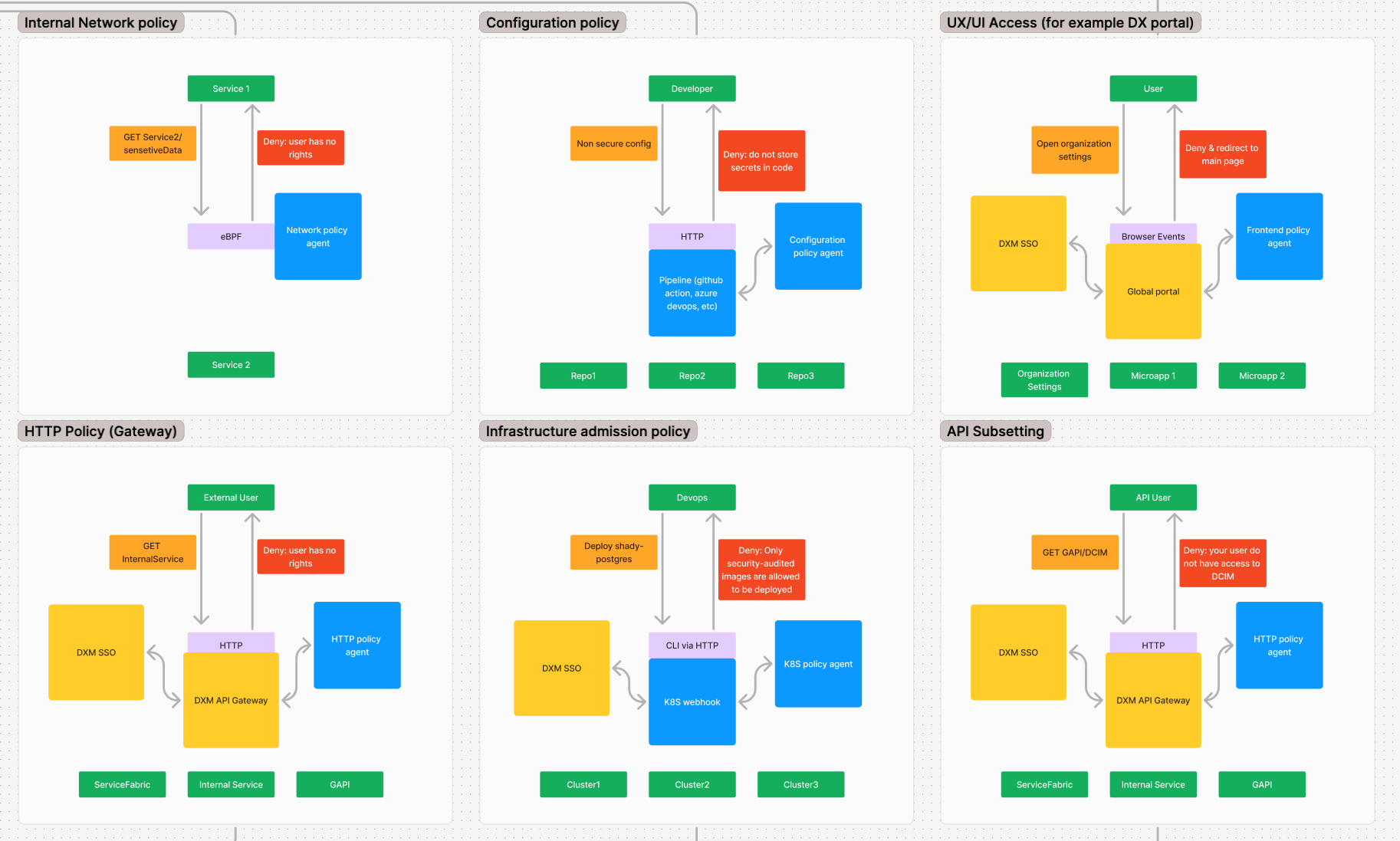
The DX Policy Engine: Building Security into the Fabric of DigitalRealty
The DX Policy Engine is a strategic tool for DigitalRealty. It moves us toward a more unified, agile, and robust security framework. It enables us to enforce our rules with precision, adapt quickly to changing needs, and free up our development teams to build more value.
This powerful engine helps us ensure that our digital services are not only innovative but also consistently secure and compliant. It gives you the confidence that our access rules are always working as intended.